
Some artifacts carry questions By: Carla Wilkins, Director The museum recently
received a remarkable and somewhat mysterious addition: a plaster mask
of Sister Mary Theresa Gassner labeled as a "death mask," generously
donated by Richard Sprute's children, Mary, Karen, Patrick and Gayle.
The mask was originally owned by Richard's mother, Angelika Sprute, who
was Sister Theresa's sibling.Death masks—plaster casts taken shortly after death to preserve a person’s likeness—were not a tradition at Saint Gertrudes. Sister Theresa passed in 1982, but this mask was signed by Sister Benita Hassler in 1981, so it raises some intriguing questions. Was it made directly from Sister Theresa at the time of her passing in 1982 and Sister Benita mislabeled the year as 1981? Or did the two women make the mask a year before Sr. Theresa's death but it was given to the family as a "death mask"? This seems more likely but the story remains unknown. What we do know is that Sister Theresa lived an extraordinary life. Born Maria Magdalena Gassner in 1882 in Flums, Switzerland, she came to the United States as a young woman and entered the Benedictine community in 1906. She went on to serve for sixty years as a teacher in Idaho and Washington, shaping generations of students in both parochial and public schools. Even in childhood, she expressed a clear sense of vocation, once telling a hermit at the age of three that she wished to become a sister. She was the first sister at St. Gertrude's to reach 100 years of age, passing shortly after that milestone birthday. Because she chose to continue to wear a habit after Vatican II, she is highlighted on our museum life platform by the coif machine. The mask offers a rare and intimate connection to that long life of service. It is, to our knowledge, the only example of its kind associated with the Monastery, making it all the more significant. This piece is on exhibit where visitors can encounter both the artifact and the questions it carries. As is often the case in museum work, history does not always arrive with clear answers—but it always invites us to look closer. 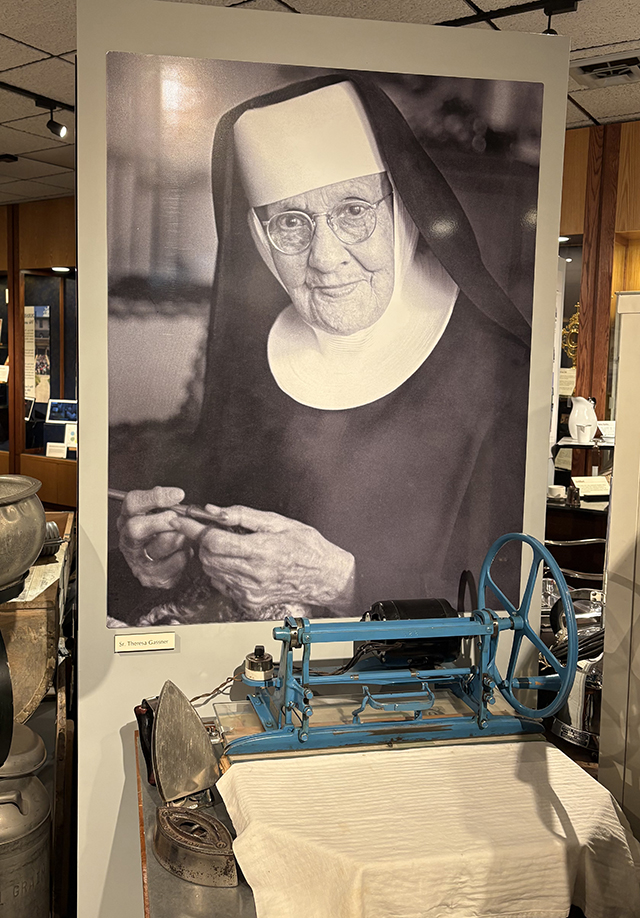 Sister Mary Theresa Gassner’s portrait in the museum is shown with a coif machine as she was one of the last to still wear a habit. 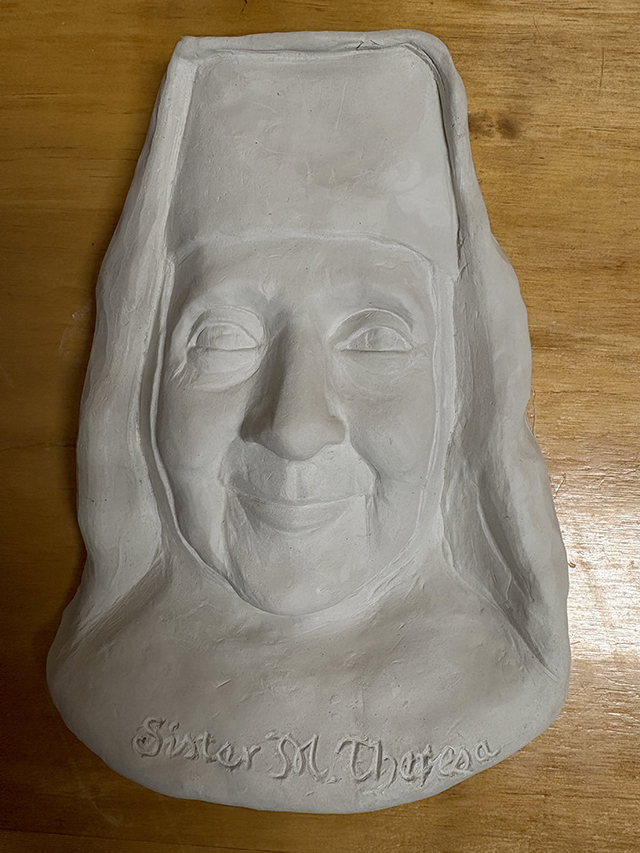 A plaster ‘death mask’ of Sr. Theresa. |