
New book available from WSU Press Prairie
author Dr. Roberta “Robbie” Tawlikitsanmay’ Paul (Woman of the Forest),
retells her family history from the early 19th century to the present,
beginning with a Nez Perce chief who met Lewis and Clark in Idaho and
continuing to a warrior who died fighting alongside Chief Joseph in the
War of 1877, three generations attending government boarding schools,
and beyond. Her work offers a new voice by an important Nez Perce
Scholar who blends her family’s history with an understanding of the
past.
Their path travels through some of the darkest periods of Native history, including the treaty-reservation experience of removal and containment; the US Military war against the Nez Perce; years of exile in prison camp; the allotment of tribal lands; and the removal of Native children to remote boarding schools. Paul incorporates themes related to racial justice, personal empowerment, and the healing of intergenerational wounds. She emphasizes the importance of Nez Perce homelands and connects pre-contact Native life with current life—reflecting an unbreakable connection of people with their homelands, ancestors, languages, and cultural practices. Her retelling adds a woman’s perspective, paying particular attention to the loss of children and offering questions about how individuals and families survived waves of great trauma. The book demonstrates a method of recovery that is rooted in both spiritual and material practice. In the book’s opening scene, Paul describes a shattering personal moment in which she comes to the brink of ending her own life but is spiritually sustained through this crisis by the love of ancestors and children. From this, she awakens to a question that propels her subsequent journey toward piecing together her family’s past, decoding sorrows that were felt but unnamed, and healing both herself and her family. Paul draws upon her dreams and intuition to guide her while enlisting the assistance of her family to follow the traces of her ancestors and create an account of their lives, utilizing not only official records, newspaper articles, and history books, but also family stories and land-based memories. “As I was researching, I could feel my ancestors with me. In history books they popped out and as if to say, ‘Look, this is what happened to me.’ When looking at old family pictures, there were times the photos would speak—in particular, one of my great-grandmother Um-al-wat Phoebe. Taken about 1890, this would have been after surviving the Nez Perce War of 1877, losing five children in the war, sending her only surviving child to boarding school, the exile in Oklahoma, returning to the Reservation at Lapwai, yet still living with purpose. When I look at this photo, I do not see a defeated woman, I see a strong, beautiful, spiritual woman saying to me, ‘Stand strong and never give up,’” Paul says. Roberta Tawlikitsanmay’ Paul is a mother, wife, grandmother, and an enrolled Nez Perce Tribal member who grew up on the reservation in the small town of Craigmont, Idaho. She was the founding Director of Native American Health Sciences for Washington State University, and has won several awards, including being selected as a Washington State University Woman of Distinction and one of the University of Washington Women’s Center’s “Women of Courage.” She received her doctorate from Gonzaga University with a research focus on intergenerational traumas and healing. Published by Washington State University Press, Listening to the Birds is paperback, 6" x 9", 318 pages, and lists for $27.95. It is available through bookstores nationwide, direct from WSU Press at 800-354-7360, or online at wsupress.wsu.edu. A nonprofit academic publisher associated with Washington State University in Pullman, Washington, WSU Press concentrates on telling unique, focused stories of the Northwest. 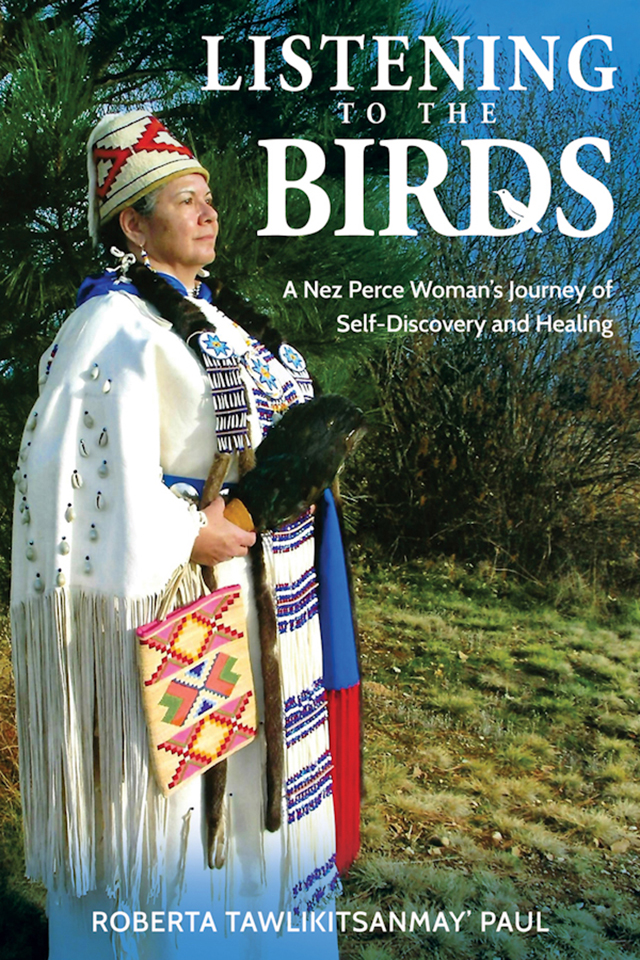 |

 |