
Corey Baerlocher to be inducted into hall of fame 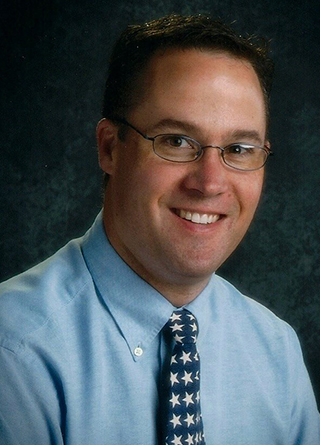 his is the seventh class of inductees. his is the seventh class of inductees.Included among the inductees will be Colfax coach Corey Baerlocher. Baerlocher was born and raised in Cottonwood, Idaho, a small rural farming community similar to the one he now calls home. It was in Cottonwood that he learned the core values that have guided him throughout his teaching and coaching career. His commitment to setting high expectations and encouraging students and athletes to strive towards them has roots in his own upbringing. From an early age, Corey’s competitive spirit was fostered within his family, where even everyday activities turned into contests filled with friendly banter. He remembers frequently losing to his mother in games like tic tac toe, slapjack, and arm wrestling. Each one ended the same, with her wishing him better luck next time. And yes, he did finally beat her in arm wrestling…when he was 25. While his mother instilled his will to win, his passion and understanding of basketball was shaped by time spent in the gym with his father, Milton, who coached junior varsity boys’ basketball at Prairie High School in Cottonwood for over 20 years. Milton’s teams never had a losing season. As a grade school student, Baerlocher recalls rushing home after school hoping to go to his father’s basketball practice. “Growing up one of the worst punishments was to be told I had to stay home and couldn’t go to the gym.” Sitting on the bench with his father during games, the younger Baerlocher learned lessons that influenced his own coaching style, such as the value of sportsmanship and not running up the score, the importance of community, and how to tell a good story. After graduating college, Corey accepted a teaching position on the Air Force base in Mountain Home, Idaho. Shortly after, he was asked to coach the girl’s junior high basketball team, and he agreed immediately, only to learn it would be the program’s inaugural year. Out of 24 girls, only two had played organized basketball before. Two games into the season, Corey shifted his goals from winning to simply scoring double digits in a game. When the team achieved this milestone, he called a timeout to celebrate, even though they were down by 40 points. That first season at Stephensen Middle School, the Spartans won just one game. Corey credits Dean Williams, a fellow teacher and score clock operator, for helping him grow through thoughtful conversations. One memorable conversation occurred when he encouraged Corey to use timeouts to teach his players regardless of the score, advice Corey embraced throughout his coaching career. The next year, the team improved, winning four games, and Corey was invited to help coach the junior high boys’ basketball team. The following year he moved up to coach Junior Varsity girls’ basketball and baseball at Mountain Home High School. During this time, he became a student of the game. He recalls sitting on the varsity bench beside assistant coach Pam Pember, a former college and pro player, and listening to her talk about the adjustments that needed to be made at halftime. “I looked at her list and was amazed by everything she had written. I thought she must have written them down before the game.” When he asked her about the lengthy list, she told him that he needed to stop watching the ball and watch the game. “It completely blew my mind and changed how I looked at the game. I started recording college games on VHS so I could practice ‘watching the game.’”It didn’t take long before he was sitting on the other end of the bench by the Sophomore coach, Travis DeVore, sharing this knew found wisdom. Following his time in Mountain Home, Corey took a position as a history teacher and a high school assistant football coach in Kellogg, Idaho. There he teamed up with Coach Lisa Cheney, who had recently returned to teach and coach in her hometown after coaching in Nampa, Idaho, one of Mountain Home’s rivals. After being hired, Corey was asked to coach girls’ junior varsity basketball, a role he enthusiastically took on. He recalls that Coach Cheney might not have initially been as excited about the new addition to her staff. “She said she just remembered me as the loud coach from Mountain Home. Which would be a fair assessment.” Their friendship, and her mentorship, proved to be invaluable in Baerlocher’s development as a coach and leader. She had an ability to break down complex ideas into understandable pieces and was meticulous in her attention to detail. Corey fondly remembers asking her to breakdown the “Globetrotter Weave,” an offense he had face numerous times while she was a coach in Nampa. Little did either of them know, that three years later, he would be running the “Globetrotter Weave” while winning his first State Championships. During his stay in Kellogg, Corey also had the opportunity to work on the football staff. He is quick to credit head coach Tim Kimberling with teaching him the art of breaking down game tape. “I thought those guys were crazy. They would have Sunday film sessions and would ask me to break down player tendencies. Things like if a player places his left foot slightly back, it’s a sign they are going to run a certain play. I had never watched film like that.” That work ethic and attention to detail proved to be crucial in Baerlocher’s success during his time as a head basketball coach. Reflecting on his early days as a young head coach in Colfax, Baerlocher quickly pointed out the support he received from former Kellogg High Athletic Director Glen Payne. Baerlocher remembered the challenges of implementing a new system within an established program. When he turned to Payne for advice, Payne asked if he truly believed in his approach. Upon answering yes, Baerlocher was caught off guard by Payne’s response: “That’s good, because if you don’t, why would they?” Coach Payne encouraged him to remain confident and committed to his plan—a piece of advice that proved invaluable to Baerlocher over the next eighteen years. In 2002, Corey accepted his first head coaching position at Colfax High School, leading the girls’ basketball team, as well as coaching junior high girls’ basketball and JV softball. There was no teaching assignment tied to the coaching position, so Corey worked as a long-term substitute the first year and an instructional aide the second year. He recalled, “the first two years in Colfax were tough.” To save money on daycare, his wife Melissa, a registered nurse and Colfax High Alum, worked nights so she could be home with their two young children during the day. Reflecting on his wife’s willingness to take on working nights, and raising two very active boys, Corey stated, “Throughout my coaching career my wife and family have always made huge sacrifices.” Those sacrifices allowed him to focus time and energy on honing his craft. Over the next 18 years he would amass a 397-108 record, while taking his team to 16 State tournaments. In his tenure at Colfax, the girls’ basketball team won an impressive eight State Championships while going 44-11 in State tournament play. While competing at the 1A classification, they set themselves apart by becoming the first program, regardless of classification or gender, to win four consecutive titles (2004, 2005, 2006, 2007). They followed this with back-to-back State Championships in 2009 and 2010 at the 2B level and were again crowned Champions in 2014 and 2018. During this time the Colfax girls also brought home two fourth place finishes in 2003 and 2008, and a sixth-place finish in 2015. They were crowned District Champions eight times, and Regional Champions ten. During his time at Colfax, Corey was honored by being named League Coach of the Year in 2006, 2007, 2009, 2010, 2012, 2013, 2015, and 2018. He was selected Washington class 1A Associated Press Coach of the Year three times (2005, 2006, 2007) and 2B Associated Press Coach of the Year in 2009 and 2018, as well as Washington State Coaches Association 1A Coach of the Year in 2006, and 2B in 2009, 2010, and 2018. He was also selected as the 2009 National Federation of High Schools Girls Basketball Coach of the Year for the state of Washington. To maintain their edge, the Colfax girls made sacrifices and worked hard. During his early years in Colfax, the girls’ basketball teams routinely played close to 60 games during the summer. This gave them opportunity to learn from mistakes during the offseason, which translated into success during the regular season. Corey’s favorite memories are filled with stories about team camp, tournaments in Medical Lake, and spending time with his players and coaching staff. Another factor he felt helped Colfax keep its edge was the fact that the varsity and junior varsity squad practiced together every day. “We always wanted our younger kids in the gym with the varsity. Not only were they role models, but when you can get the younger kids reps against one of the best teams in the state, it can’t help but make them better.” This philosophy appeared to work, especially during his first eight years when they won six titles. Corey is quick to share credit for his success in Colfax with not only those coaches that joined him on the bench, but also the youth coaches that worked with his players as they grew up. “The foundation of each of those seasons was established years before by coaches in our youth program. The winning tradition was in Colfax long before I showed up.” During his first season in Colfax, he had a team manager copy school yearbook photos of every team that had made it to State. To this day, those copies are still in his coaching bag. “It was a reminder that this program was bigger than me. It wasn’t just the girls that were on the team that year, or those coming up the following. Colfax had a strong tradition before I arrived, and I wanted to make sure the girls playing for me knew that.” Although Colfax had a tradition of success, including a 2nd place finish and a 1A State title before Baerlocher’s arrival, he played a crucial role in sustaining their prominence at the top of the 1A and 2B classifications. “I am forever grateful for those players, and coaches, that embraced the hard work and made the sacrifices to continue adding to the tradition of Colfax girls’ basketball. And to my family, thank you for making the ultimate sacrifice and allowing me to chase this crazy game.” 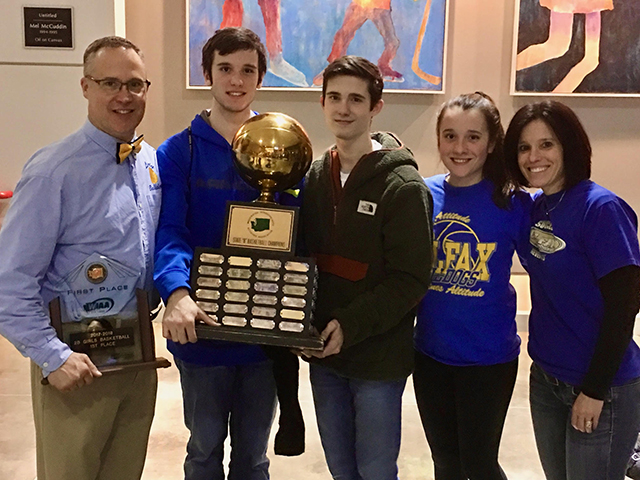 Corey Baerlocher with his family after his Colfax team won the 2018 state championship. 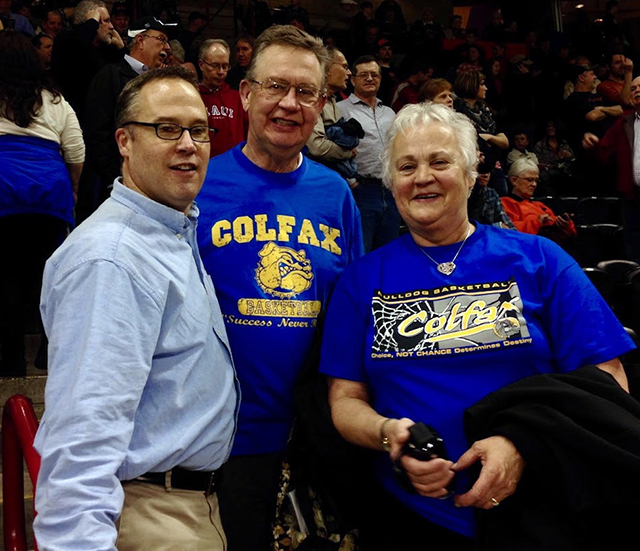 Corey with his father Milton and mother Shirley in 2014.
| COTTONWOOD
|