
New life for Idaho's historical markers By: Carla Wilkins, Director
For decades, Idaho’s highway historical markers have
dotted the landscape, offering brief glimpses into the state’s rich and
varied past. But time has not been kind to them. Many of the signs are
now faded, damaged, or entirely missing. That’s why Keith Petersen,
former Idaho State Historian, has taken on the immense task of editing
and refreshing the nearly 300 historical signs scattered across the
state. Petersen is working for the Idaho State Historical Society and
the Idaho Transportation Department, the agencies that oversee the
highway markers program.
These markers were originally installed over many years beginning with eighteen signs erected in 1956. The bulk of the markers were erected in the period between the 1950s and the 1970s, without a master list or consistent oversight. As a result, the historical narrative they tell is incomplete and, at times, inconsistent. Recognizing this, Keith began the project by conducting an inventory to determine what stories were told—and more importantly, what stories were missing. For instance, in Northern Idaho, sixteen markers discuss the region’s mining, but only one was dedicated to its important logging industry. There is a marker about Farragut Naval Station near Coeur d’Alene that trained over 300,000 naval cadets during World War II, but no marker devoted to the Navy’s ongoing testing of submarines at Lake Pend Oreille after the war. About 45 markers describe the journeys of Lewis & Clark and Oregon Trail travelers – people who were eager to pass through Idaho as quickly as possible but absolutely did not want to stay. Only three honored women. Historians have also uncovered new information since 1956, debunking long-held myths – such as the tale that Idaho’s jagged border with Montana was the result of a drunken surveyor crew. A new marker will explain how that border was drawn. The original signs were limited to just 75 words, a restriction that often made it difficult to fully capture the importance of a place or event. The new markers allow up to 100 words, which allows space to tell richer, more engaging stories. They will also be made of metal, ensuring they can better withstand the elements and remain legible for years to come. Keith is not just updating the existing signs. He is tasked with adding 100 brand-new ones to the highway system. One of these new markers will honor the Monastery of St. Gertrude. It will be situated along Highway 95 at the turnout near Bud’s Power Sports, about two miles south of Cottonwood. To celebrate this addition, the Historical Museum at St. Gertrude had a replica made for Keith’s recent presentation. It was unveiled during the event and now hangs in the museum’s entry. Idaho County currently has 23 markers—more than any other county—and will soon have six more as part of the 400 Idaho stories told along Idaho’s highways. Keep an eye out—your next road trip might just bring you face-to-face with a story you’ve never heard before. 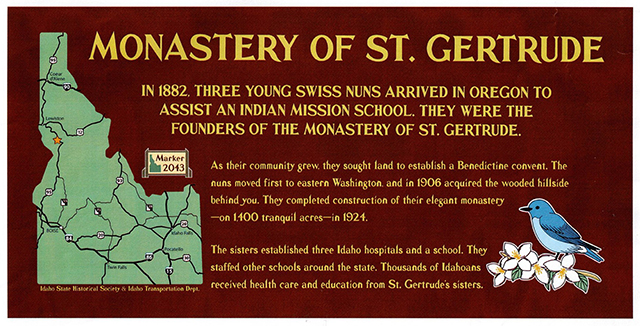 |

Home Classified Ads
 |