
Scripts and photos of the Living History event Museum Director Carla Wilkins shared the scripts read by the living history actors at the Historical Museum’s event Saturday, August 2. MOSES MILNER (Thomas Eier) His Kentucky Mare is played by Jean Melching I was born in 1829, left
home as a teenager and worked as a trapper, then during the
Mexican-American war, as an army packer, teamster and eventually as a
scout. I had a Kentucky mare I raced and when a man doped it so she
wouldn’t win, I shot him.I moved to California in search of gold and somehow earned the nickname, “California Joe”. I married, had kids and lived for a time on a 640-acre cattle ranch near Corvallis, Oregon. I came to the Camas Prairie looking for gold. I filed a homestead claim and built a small cabin, naming the area “Mount Idaho”. I cut out a trail to the gold town of Florence, now known as the Milner Trail. Charging a toll for travelers on this new route was a great source of revenue. I then built a small tavern too. One day, a traveler stole my Kentucky mare. While chasing him, I took a shortcut and when the thief rode by, I shot him. I left a note on his body saying, “Warning to horse thieves, Moses Milner, Mt. Idaho.” I was attacked by a cougar near Mt. Idaho. I killed the cat but my wounds were bad enough that I was bed-ridden for weeks. My wife came from Corvallis to nurse me. The following spring I sold my toll road and farm to L.P. Brown. In 1866, I returned to work as a scout for the army. While in Kansas, I became friends with Wild Bill Hickok and Texas Jack. Wild Bill was murdered in 1876 in Deadwood playing poker. When I heard, I went looking for the killer but could not find him. In 1868, General George Armstrong Custer appointed me as Chief of Scouts. The gig didn’t last long, however, as I was drunk when Custer needed me. Custer and I remained friends. He died at Little Big Horn nine years later. Just after Custer’s death, I was shot in the back and killed by Tom Newcomb. We had a running dispute involving the deaths of two men but he killed me in cold blood from 100 feet away. The coward fled and was never brought to justice for my murder. I was only forty-seven years old. 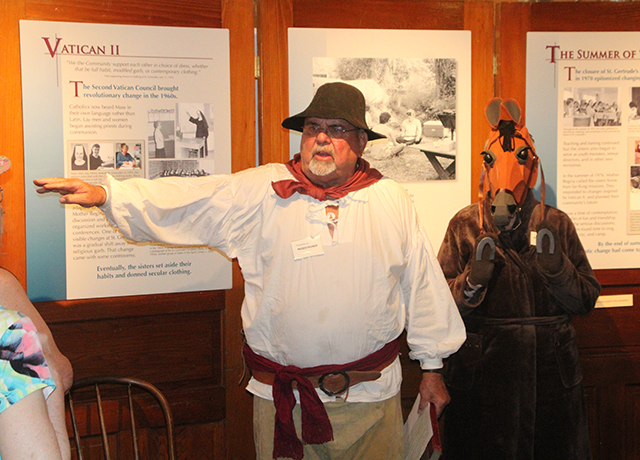 Tom Eier as Moses Milner with Jean Melching as his Kentucky Mare. LOYAL P. BROWN (Cody Uptmor) I was born in 1838 in Austria. I first emigrated to New Zealand and later to the U.S.My name is Loyal P. Brown but everyone
calls me L.P. I was born in New Hampshire in 1829 and came to Idaho
County to mine gold in Florence. While passing through Mt. Idaho, I
saw a good business opportunity, ditched the idea of panning for gold
and bought Moses Milner’s toll road and tavern instead. Although Moses
named Mt. Idaho, I was responsible for making it flourish. JERRY JOHNSON (Malek Davarpanah)I became the postmaster for a time and established a blacksmith shop. I replaced Milner’s tavern with a larger hotel, built a sawmill and a flour mill. You may not know that Idaho County was established as part of the Idaho Territory before Idaho ever became a state! I served two terms in the Idaho Territorial Council and was able to pass a bill in 1875, to make Mount Idaho the new county seat which helped my businesses tremendously. I donated the land for the new courthouse I also brought the first Hereford cows to the Camas Prairie and owned 6,000 sheep. I expanded my business holdings to Cottonwood -- building a post office, blacksmith shop and hotel there too! Sarah and I owned the Mount Idaho Hotel until my death in 1896. Mt. Idaho faded away when the county seat moved to Grangeville in 1902. 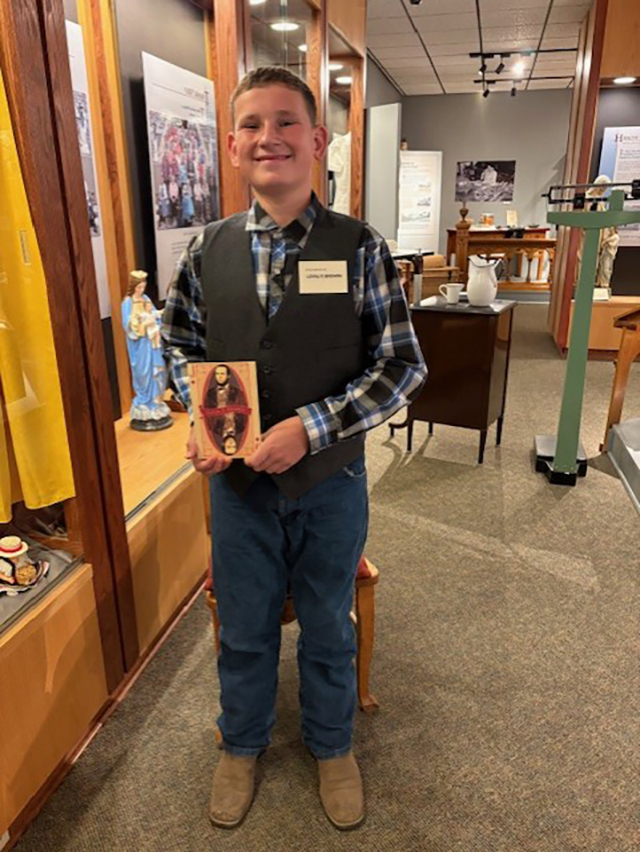 Cody Uptmor portrayed Loyal P. Brown at the Living History event. Photo by Carla Wilkins. In 1886, Billy Rhodes and I discovered a silver ore deposit near Blacklead Mountain. I knew it would take too much money to develop it so wanted nothing to do with it. I was only interested in placer gold, but Billy stayed to mine. Billy Rhodes has a road and mountain named after him even though he didn’t do anything particularly important. I liked the upper Lochsa and had a cabin in the area of what is now known as Jerry Johnson Hot Springs. In 1893, I was in my cabin when members of the ill-fated Carlin Hunting Party came by. The six fools went on a poorly planned hunting trip and became trapped by high mountain snows. They built rafts to try to raft down the Lochsa. They wanted me to keep their camp cook, George Colegate as he was dying from a bladder issue. I didn’t want him and he didn’t want to stay with me. He was eventually abandoned by the group as he was too sick to walk when they couldn’t raft any further. His grave is located beside U.S. Hwy 12 at the Colgate Licks rest area which was named after George simply because he died near there. You can read about us all in the book Snowbound. I died at age 73 in 1911, and am buried in Wallace, Idaho. In addition to Jerry Johnson Hot Springs, Jerry Johnson Campground on the Lochsa River is named after me for no other reason than I was nearly the only person living near there. Other places around Idaho County that were named after people who did not do anything particularly important are Doumecq which was named after a French farmer and they named Riggins after its Postmaster which had a better ring to it than its previous name of Gouge Eye. You can find my picture in the pinochle deck, but I’m not in the poker deck. 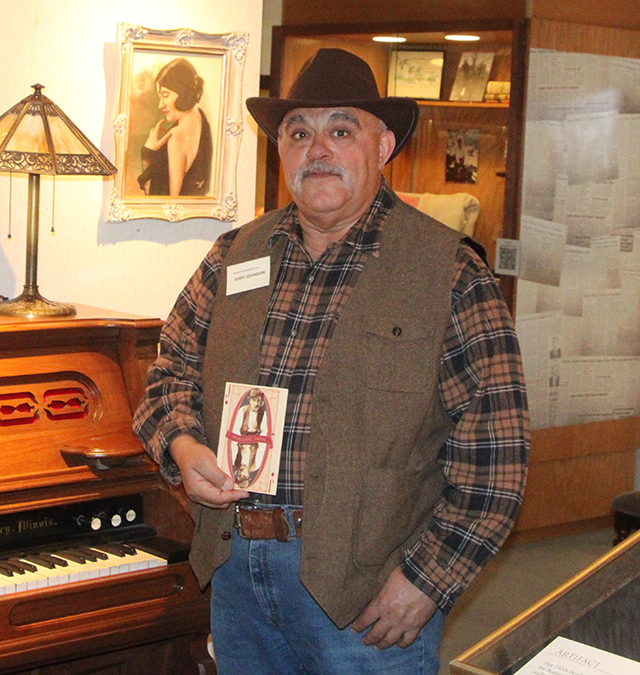 Malek Davarpanah portrayed Jerry Johnson, the one Jerry Johnson Hot Springs is named for, at the Living History event. SUE MCBETH (Taylor Wilkins) I was born in Scotland, in 1830. My sister Kate and I immigrated to the United States to be Presbyterian missionaries.After Henry Spalding’s death in 1874, we went to Kamiah and built upon the previous missionary work done by him. The Kamiah Presbyterian Church was built in 1874 is now the oldest protestant church in continuous use in the State of Idaho. The cabin Kate and I built in 1880 to live in and use as a school also still stands and is listed on the National Register of Historic Places, along with the church. Kate and I provided education and religious instruction to the tribe. I taught religious instruction to the Nez Perce men and Kate focused on literacy and domestic education for the Nez Perce women. I was a scholar and gifted linguist and compiled a Nez Perce/English dictionary which aided our communication greatly! Around 1885, we encountered difficulties working with the government’s Indian agent, and we left Kamiah. I went to Mount Idaho and continued my work with the Nez Perce. Kate moved to Lapwai to work and wrote a book called The Nez Perces since Lewis and Clark, which gives the perspective of what our work entailed. I died in Mount Idaho in 1893 and am buried in the cemetery beside the Presbyterian Church in east Kamiah. Kate continued her work until her death twenty years later. 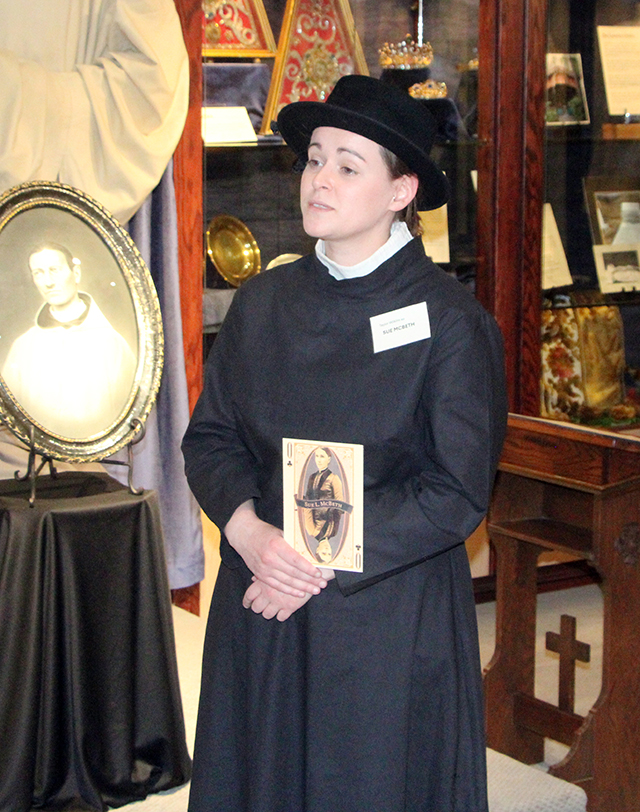 Taylor Wilkins as Sue McBeth Camas Flower (Katie Uptmor) I am a blue camas flower
and here are my friends and family (point to the photo). My photo
is on the Ace in both the poker and pinochle deck.I am harvested when I am in full bloom in spring or early summer. My bulb tastes a lot like a sweet potato but a little sweeter. It’s important you harvest me when I’m in bloom so you don’t mistake me for white camas because those bulbs look like mine but are poisonous. Camas was very important to the native Americans. They cultivated us, sometimes burning our fields so we had a better place to live and then replanting. My bulb has more protein per pound than salmon. Eating camas helped the Lewis & Clark party survive. Different places in Idaho are called Camas because I am so important. 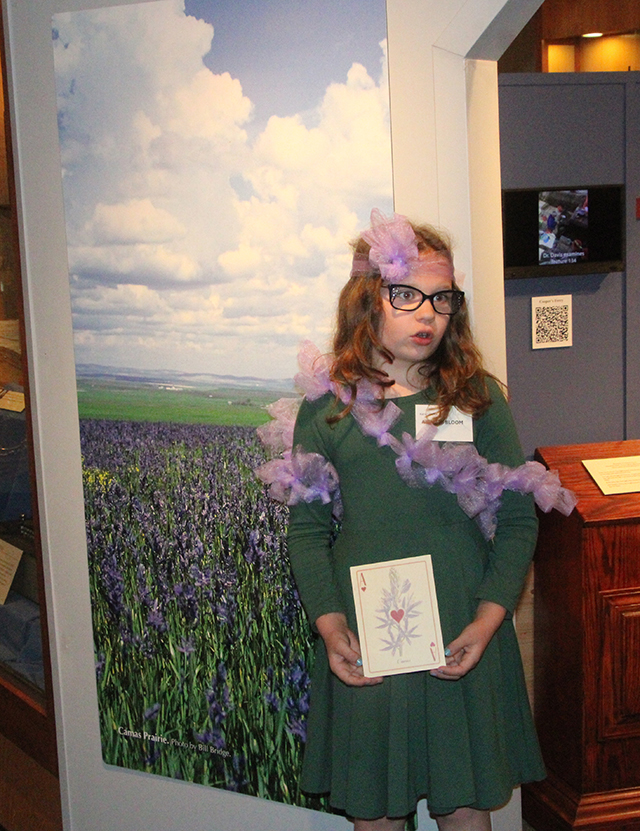 Katie Uptmor as a Camas Flower. Camas roots were a food source for the Native American population in the area. Anna Seubert Jenny (portrayed by her great, great granddaughter, Alaina Lustig) My name is Anna Kees
Seubert Jenny. I was born in Wisconsin in 1869 and met my first
husband, Georg Seubert there. Georg was a widower who had five children
with my distant cousin. I looked after the children after my cousin’s
death and married Georg in 1889. We came to Cottonwood, Idaho a month after our marriage by wagon, ferry boat and stage, and had a successful farm. We helped start the Catholic Church in Cottonwood and we also donated the land for the two cemeteries in Cottonwood. After nine years of marriage, Georg died in 1898. I was pregnant with our seventh child, responsible for five stepchildren, and had a farm to run. Together with the help from the older children, I managed it and even increased the size of the farm by buying additional acreage. Five years later, I married Jacob Jenny. We added six more children to our family, one of whom died at five months of age, so I parented 17 children. We continued to farm and raise stock on the ranch I started with Georg. Jacob was deeply involved in the community; including being elected to the Idaho legislature multiple times, appointed to the State Board of Education and serving on the Board of Regents for the University of Idaho. Jacob died in 1954. I lived another 10 years until the age of 94. 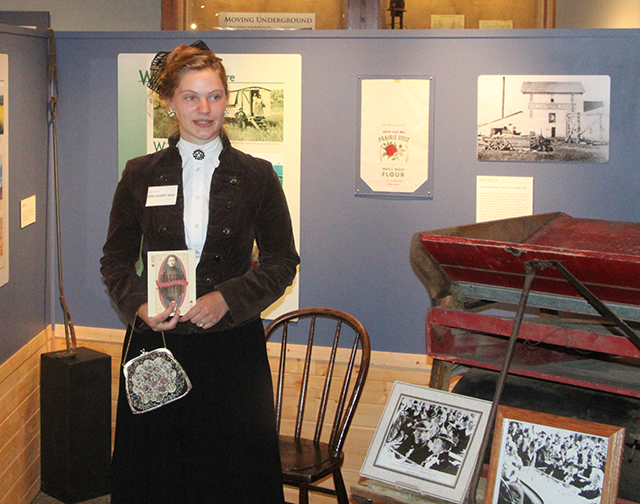 Alaina Lustig portrayed her great-great grandmother, Anna Seubert Jenny at the Living History event Saturday. The photographs at lower right show Jenny riding with Eleanor Roosevelt in a parade in Spokane. Sister Hildegard Vogler (Jody Davarpanah) I’m Sr. Hildegard Vogler. I
was born in Switzerland in 1867 next door to Mother Johanna Zumstein,
who led the Sisters to America. I came to America at age 23 to
join the convent when it was in Uniontown, Washington. When it became
too full, we all made the move to Colton but it also became too
full. Since we had a beautiful campus and successful school in
Colton, we decided to split the community with Mother Johanna staying
in Colton and continuing to run our school there and I would lead
another group to a new location. We would still be one group of
Sisters, but with two convents.John and Gertrude Uhlenkott, who had two daughters in our convent, offered to give us 85 acres of land if we settled in Cottonwood. I led a group to Cottonwood to establish a convent which we voted to make our motherhouse. We had two convents for 25 years. I was the prioress in Cottonwood for 18 years from 1902 to 1920 and made three trips to Switzerland to bring candidates to St. Gertrude’s. I was responsible for building our first convent and was the prioress as we started building our current convent in 1919. Mother Johanna passed in 1926. Five years later, we sold the Colton convent and everyone came to Cottonwood. I am the Foundress of St. Gertrude’s and am in both the pinochle and poker decks. I died at age 89. 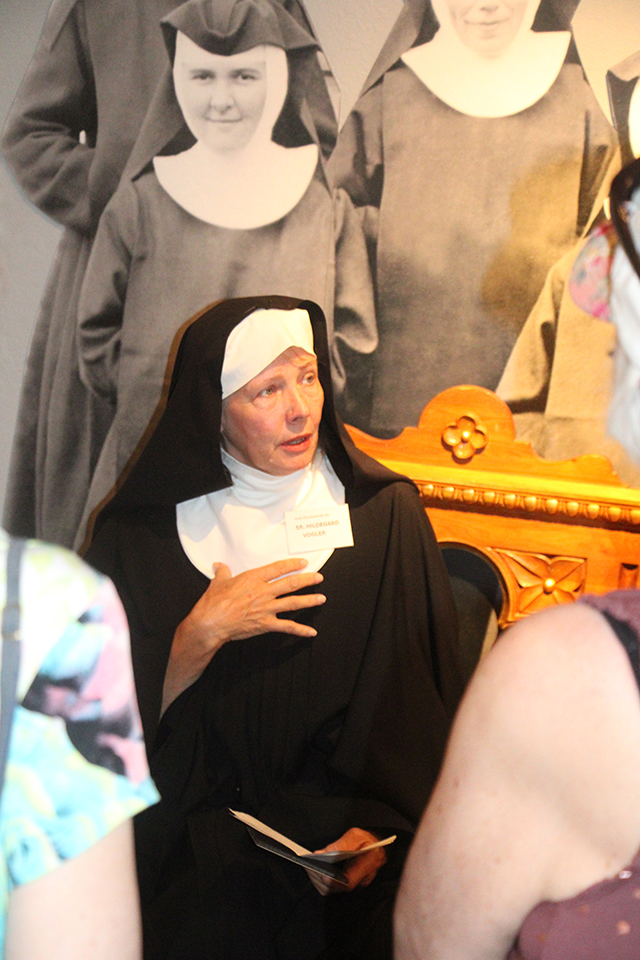 Jodi Davarphanah portrayed Sr. Hildegarde Vogler, the last surviving of the original nuns who came from Switzerland.. Sister Alfreda Elsensohn (Leah Uptmor) My name is Sister Alfreda
Elsensohn. I was a science teacher at St. Gertrude’s Academy and
began using a collection of minerals donated by the Smithsonian
Institution as teaching tools. My students and I gathered other
objects, rocks, insects, and animals, and I also taught
taxidermy. The students’ families also donated artifacts. As the
collection grew, I organized a museum in the attic of the Academy in
1931 which was one of Idaho’s earliest museums. This is a replica
of my museum and everything here was gathered or donated from 1931 to
1939 with a couple of exceptions. The highest museum award you can get in Idaho is the Sr. Alfreda Award which comes with $10,000. It is given jointly by the Idaho Humanities Council and the Idaho State Historical Society. I was also interested in Camas Prairie history. I wrote four books and two of them, Pioneer Days, are considered the premier history books of Idaho County which is why I am in both the poker and pinochle card decks. 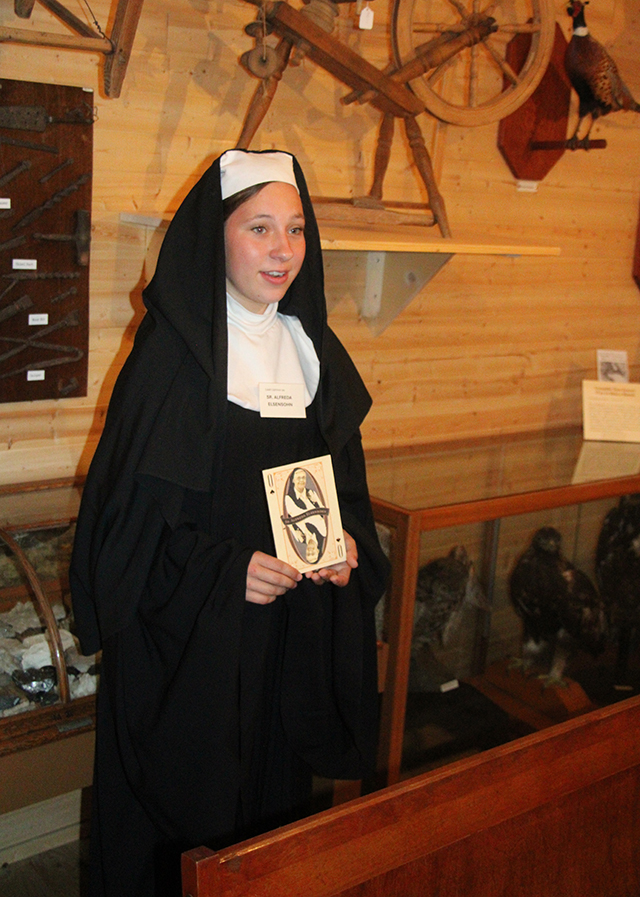 Leah Uptmor as Sr. Alfreda Elsensohn in the exhibit which is a replica of the attic where Sr. Alfreda started the museum. |
|
|
|
|